
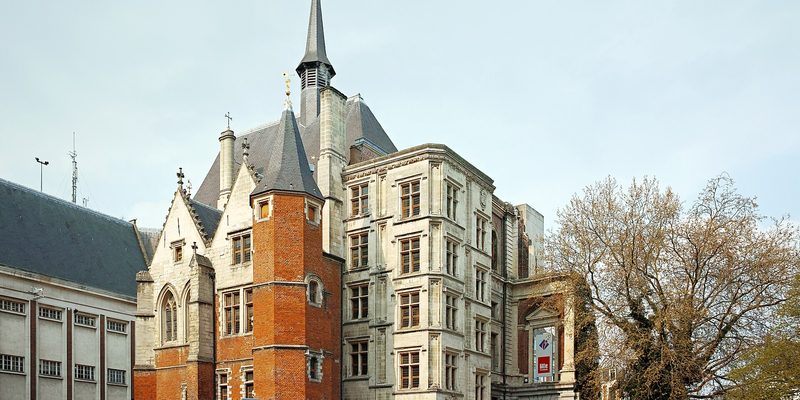
At the end of the square that bears its name, the Palais Rihour is what remains of one of the largest palaces in northern Europe. What survives amounts to two rooms — and that is enough to tell five centuries.
A ducal palace in the fifteenth century
Construction began in 1453 at the instigation of Philip the Good, Duke of Burgundy. Lille was then one of the capitals of a state stretching from the Low Countries to Burgundy, and the palace was meant to be its showcase: state rooms, a chapel, gardens.
It was here in 1454 that the Feast of the Pheasant took place, one of the most famous episodes of the Burgundian court, at which the guests swore an oath to go on crusade.
What a fire left behind
In 1700, a fire destroyed most of the palace. The buildings were then altered, cut back, and largely demolished in the nineteenth century. All that remains today are the Guards' Hall and, upstairs, the Conclave Room, with its barrel vault and stained glass.
The contrast is striking: from outside, a discreet building wedged into the urban fabric; inside, an intact fragment of the fifteenth-century Burgundian world.
Visiting
The palace now houses Lille's tourist office, which makes the ground floor freely and permanently accessible. It is also the most practical starting point for organising a visit to the city, particularly during the Braderie, when Place Rihour is one of the weekend's convergence points.
To continue: the Vieille Bourse is a three-minute walk away, and the centre's Flemish architecture follows on naturally.