
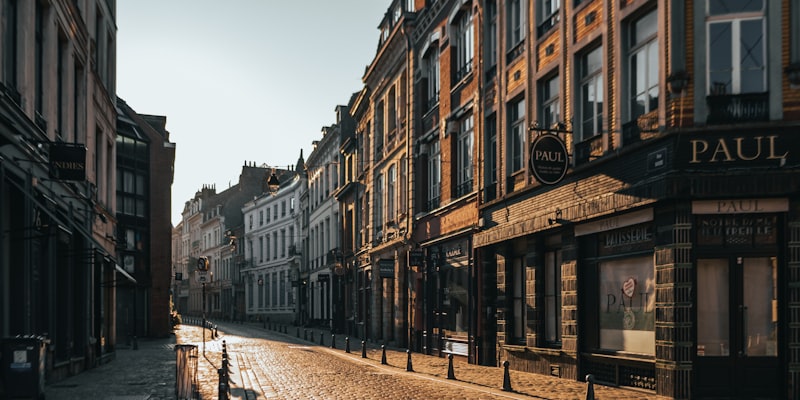
To the north-west of Lille's city centre, protected by its moats and bastions, the Vauban Citadel stands majestically at the heart of a lush green setting. Described by its creator as the "queen of citadels", this pentagonal fortress is one of the finest examples of 17th-century military architecture in Europe. A look at one of Lille's most iconic monuments.
The conquest of Lille by Louis XIV
The history of the Citadel is inseparable from the French conquest of Lille. In 1667, during the War of Devolution, Louis XIV seized the Flemish city after a nine-day siege. Keen to maintain lasting control over this strategic position on the kingdom's northern border, the Sun King entrusted his military engineer Sébastien Le Prestre de Vauban with building an impregnable citadel.
Construction began in 1668 and involved over 2,000 workers for three years. Vauban designed a structure of remarkable geometric perfection, incorporating the most advanced principles of bastion fortification. Lille's rich history is profoundly shaped by this period of incorporation into France.
A masterpiece of engineering
The Citadel of Lille follows a regular pentagonal plan, with five bastions connected by curtain walls and protected by a complex system of half-moons, tenailles and flooded ditches. The whole forms a virtually impregnable fortification, capable of withstanding the most elaborate siege techniques of the era.
Within the walls, Vauban designed a veritable city within a city, with barracks, an arsenal, a chapel, powder stores and officers' quarters. The Porte Royale, the main entrance to the Citadel, is a remarkable example of classical architecture adorned with a sculpted pediment bearing the arms of France.
Inscribed as a UNESCO World Heritage Site
In 2008, the Citadel of Lille was inscribed as a UNESCO World Heritage Site as part of the Vauban fortifications network, alongside eleven other sites in France. This international recognition underlines the outstanding universal value of Vauban's work and its influence on the art of fortification worldwide.
The Citadel remains an active military installation, housing the headquarters of the Rapid Reaction Corps – France, making it one of the oldest citadels still in military use in Europe. This dual role — heritage and military — gives it a unique character.
The Citadel park: Lille's green lung
The area surrounding the Citadel is laid out as a vast park that forms the largest green space in central Lille. The Bois de Boulogne, with its 60 hectares, provides an ideal setting for walking, jogging and relaxation. The tree-lined paths run alongside the canals and moats, offering picturesque views of the fortifications.
The Lille Zoo, located within the park, is a very popular attraction for families. Free and open to all, it is home to over 70 animal species in a carefully landscaped environment. Playgrounds, sports facilities and picnic areas complement the park's amenities, which also hosts cultural and sporting events throughout the year.
Visiting the Citadel
Although the Citadel is still an active military installation, guided tours are regularly organised, particularly during the European Heritage Days in September. These tours allow visitors to explore the interior of the fortress, its underground passages, barracks and chapel, accompanied by passionate guides who bring the monument's history to life.
The exterior circuit of the Citadel is freely accessible and makes for a very pleasant walk of around four kilometres. The route offers remarkable views of the bastions, moats and the defensive system designed by Vauban. It is also a popular cycling route, easily accessible via the V'Lille network.
The Citadel and the Braderie de Lille
During the Braderie de Lille, the Citadel park offers a welcome haven of peace for bargain hunters wishing to take a break from the crowds. The Belfry of Lille, another iconic monument, completes the city's heritage panorama and is another major point of interest to discover during your stay. Check the Braderie map to best plan your route between heritage and bargains.